


Taiwan’s annual FDI headline understates the relationship by an order of magnitude. In 2025, Taiwan registered US$965.8 million in newly licensed project capital in Vietnam, placing sixth among source countries for the year according to the General Statistics Office. The full picture looks materially different: cumulatively, Taiwan has invested approximately US$39.5 billion across nearly 3,200 projects, making it Vietnam’s fourth-largest foreign investor by all-time registered capital and its second-largest ASEAN source of FDI after Singapore. For Taiwanese investors evaluating Vietnam, understanding why the gap between headline and reality exists, and what the full picture reveals, is the essential starting point.
The Three Numbers That Tell the Real Story
Newly Registered Capital: The Headline Figure
Newly registered capital measures only new project approvals within a calendar year. Taiwan’s US$965.8 million in 2025 reflects approximately 39 new investment projects concentrated in electronics, garments, textiles, and electrical equipment. It is an accurate but incomplete metric: it captures new commitments entering Vietnam’s foreign investment register, not three decades of accumulated Taiwanese capital and industrial ecosystem development.
Capital Adjustments: The Commitment Signal
Capital adjustments, expansions of existing project registered capital, reveal investor conviction that new registration rankings cannot. In 2025, Foxconn expanded two projects at Quang Chau Industrial Park in Bac Giang by a combined US$320 million, a capital contribution that does not appear in annual source-country rankings but materially reflects the depth of Taiwan’s Vietnam commitment. Lite-On Technology separately committed an additional US$200 million to expand its Vietnam production capacity through the same mechanism.
Cumulative Capital: The Full Picture
The cumulative figure resolves the headline paradox. According to HSBC economists cited by Vietnam News, Taiwan’s total registered investment in Vietnam stands at approximately US$39.5 billion across nearly 3,200 projects, positioning Taiwan as the country’s fourth-largest foreign investor by all-time capital, behind South Korea, Singapore, and Japan. Annual registration data captures the front door of this relationship. The cumulative figure reflects the building.
Three Decades of Taiwanese Investment in Vietnam
From Labour Costs to Supply Chain Strategy
Taiwan’s investment in Vietnam has evolved through three distinct phases. The first wave, 1990s to early 2000s, centred on labour-intensive manufacturing: textiles, garments, footwear, and basic assembly. Formosa’s Ha Tinh steel complex anchors Taiwan’s industrial presence in central Vietnam from this era. Southern provinces, Binh Duong, Dong Nai, and Long An, built substantial Taiwanese manufacturing communities that laid the infrastructure subsequent waves would compound.
The second wave, driven by US-China trade tensions and Apple supply chain diversification, brought Foxconn, Pegatron, Compal, Wistron, and Qisda into northern Vietnam, principally Bac Giang, Bac Ninh, Hai Phong, and Vinh Phuc. These facilities became critical nodes in global consumer electronics production. Vietnam is now the second-largest smartphone exporter to the United States, a position built substantially on Taiwanese-invested manufacturing capacity.
The Third Wave: High-Tech and Semiconductors
The current investment phase is moving beyond assembly toward high-technology manufacturing. Cooler Master Corporation has invested approximately US$200 million in Bac Ninh with plans to expand its total Vietnam commitment to US$3 billion. Taiwan controls over 70% of global high-end chip market share; Vietnam is targeting a semiconductor industry valued at US$20–30 billion by 2030, supported by a programme to train 50,000 semiconductor engineers. Taiwan’s Ministry of Education has launched the INTENSE Program to train Vietnamese students in semiconductor engineering specifically for placement in Taiwanese-invested operations. The Global Taiwan Institute has identified this convergence as the most strategically significant dimension of the bilateral economic relationship for the coming decade.
Where Taiwan’s Capital Is Concentrated
Electronics and the Apple Supply Chain
Electronics dominates Taiwan’s Vietnam investment footprint. Foxconn’s operations in Bac Giang and Bac Ninh, Pegatron’s large-scale facility in Hai Phong, Compal’s manufacturing project in Vinh Phuc, and Lite-On’s expanding production capacity collectively make northern Vietnam indispensable to global consumer technology supply chains. The anchor effect is powerful: when a major Taiwanese electronics company establishes operations in an industrial park, dozens of Taiwanese component suppliers, logistics providers, and service firms follow, creating self-reinforcing investment clusters that deepen with each successive capital contribution.
Textiles and Trade Agreement Access
Textiles and garments remain a material share of Taiwan’s cumulative Vietnam position, particularly across southern provinces. Taiwanese manufacturers benefit directly from Vietnam’s 17 free trade agreements: CPTPP and RCEP grant preferential tariff access to the US, EU, Japan, South Korea, and ASEAN markets simultaneously, a multi-market export advantage unavailable to manufacturers operating from Taiwan or mainland China alone. This trade agreement leverage is a structural reason why Taiwanese textile and garment capital continues to renew and expand in Vietnam rather than relocating elsewhere.
The Binh Duong Ecosystem: What No Table Can Show
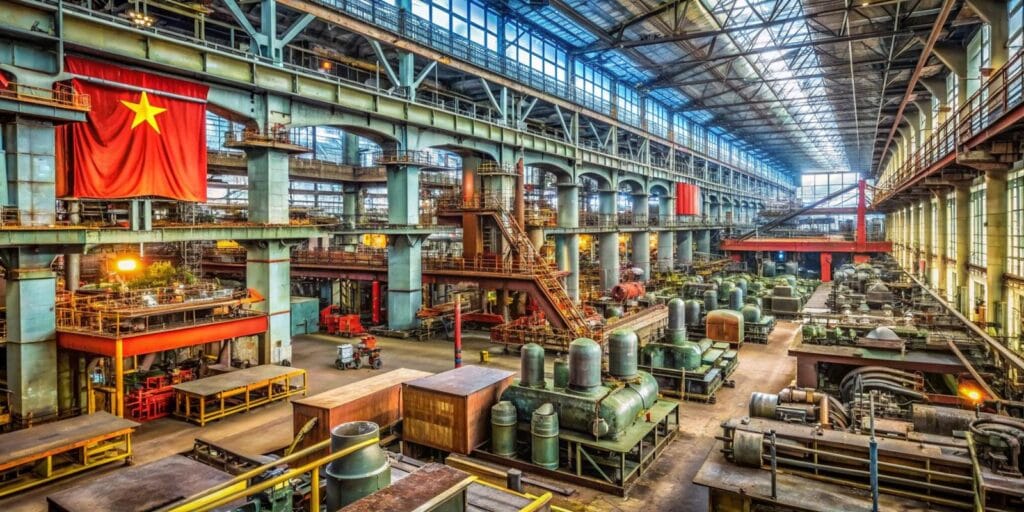
The Binh Duong industrial ecosystem is the proof of Taiwan’s Vietnam footprint that annual data cannot represent. The Binh Duong branch of the Council of Taiwanese Chambers of Commerce has more than 600 members, the largest Taiwanese chamber of commerce anywhere outside Taiwan itself. This is not a statistical artifact. It is three decades of supply chain co-location, labour relationship building, and community infrastructure that has made Binh Duong one of the most embedded Taiwanese industrial ecosystems in Southeast Asia.
The people-to-people dimension reinforces this permanence. Approximately 90,000 Taiwanese nationals reside in Vietnam, while more than 270,000 Vietnamese citizens live in Taiwan as students, workers, and spouses, with Taiwan serving as Vietnam’s largest foreign labour export market. This bilateral human mobility creates knowledge-transfer channels and institutional trust that underpin long-term Taiwanese investor confidence in ways that capital figures alone cannot capture.
Why Vietnam, Why Now
The Geopolitical Rationale
Taiwan Strait risk is a structural driver of Taiwanese companies’ Vietnam expansion that investment data reflects but rarely names. Supply chain diversification away from Taiwan-concentrated production reduces single-geography operational risk for manufacturers whose clients demand multi-country sourcing resilience. Vietnam offers geographic proximity, an established Taiwanese supplier ecosystem, competitive operating costs, and political stability, making it the primary ASEAN beneficiary of this diversification imperative.
Vietnam’s Investment Environment
Vietnam’s investment environment combines legal accessibility, fiscal incentives, and trade leverage that few comparable markets match. Under the Law on Investment 2025, Taiwanese investors may establish 100% foreign-owned companies across most business lines. High-tech manufacturing projects qualify for corporate income tax incentives of up to 15 years under Decree 57/2021/NĐ-CP. The Ministry of Planning and Investment processes Investment Registration Certificates within 10–15 working days; Enterprise Registration Certificates follow within three working days. Resolution 68, issued in May 2025, elevates private sector investment as a national development priority, signalling sustained policy commitment to a pro-foreign-investment environment.
Conclusion and Investment Implications
The USD 1.7 billion headline, or any single-year registered capital figure, is a valid but partial picture of one of Asia’s most consequential bilateral investment relationships. Taiwan’s US$39.5 billion cumulative Vietnam position, its dominant role in Vietnam’s electronics export capacity, the Binh Duong industrial ecosystem, and the emerging semiconductor convergence collectively constitute a strategic partnership that annual FDI rankings cannot represent.
For Taiwanese investors, the signals in 2026 are aligned. Electronics manufacturing will deepen as Apple supply chain commitments expand. Semiconductor investment is accelerating as Vietnam’s engineer pipeline matures. Bilateral trade, currently US$25 billion annually, will grow as CPTPP and RCEP utilisation rises. The full picture of Taiwan’s Vietnam investment is a three-decade accumulation of capital, supply chains, and relationships that makes Vietnam the most strategically important overseas manufacturing destination in Taiwan’s economic geography.
Frequently Asked Questions
How much has Taiwan invested in Vietnam in total? Taiwan has cumulatively invested approximately US$39.5 billion across nearly 3,200 projects, making it Vietnam’s fourth-largest foreign investor by all-time registered capital. Annual newly registered figures, US$965.8 million in 2025, capture only new project approvals and significantly understate this cumulative position.
Which Taiwanese companies have the largest operations in Vietnam? Foxconn operates major facilities in Bac Giang and Bac Ninh producing Apple components. Pegatron has a large-scale investment project in Hai Phong. Compal Electronics manufactures computers in Vinh Phuc. Lite-On Technology and Cooler Master Corporation are among the most active recent investors in high-tech manufacturing expansion.
How does a Taiwanese company establish operations in Vietnam? Under the Law on Investment 2025, Taiwanese investors must obtain an Investment Registration Certificate from the Department of Planning and Investment or the relevant industrial park management board, a process taking approximately 10–15 working days, followed by an Enterprise Registration Certificate within three working days. Post-establishment requirements include opening a direct investment capital account and registering for tax.
Is Taiwan investing in Vietnam‘s semiconductor industry? Taiwanese semiconductor-related investment is accelerating. Taiwan controls over 70% of global high-end chip market share, and Vietnam targets a US$20–30 billion semiconductor industry by 2030. Taiwan’s INTENSE Program trains Vietnamese students in semiconductor engineering for placement in Taiwanese-invested operations, and component manufacturers, optical producers, and IC packaging firms represent the current vanguard of this investment wave.