


For much of the past decade, Southeast Asia’s offshore wind story has been told in megawatts and policy pledges that failed to materialise. Vietnam is changing that narrative, fast. With a revised national energy blueprint, a landmark bilateral partnership with the United Kingdom, and billions of dollars in dedicated finance already committed, the conditions for a genuine UK-Vietnam offshore wind investment corridor are, for the first time, genuinely in place. For UK developers, project finance teams, and supply chain businesses, the window to act is now.
What Is PDP8 and Why Does It Matter for Offshore Wind Development?
PDP8, Vietnam’s Power Development Plan 8, is the national masterplan governing the country’s electricity generation, renewable energy targets, and infrastructure investment through to 2050. First approved in May 2023 under Decision 500, the plan was significantly revised in April 2025 via Decision 768, and the revision changes the investment calculus considerably.
Under the original PDP8, Vietnam targeted 6,000 MW of offshore wind power capacity by 2030. The revised plan raises that target to a range of 6,000–17,032 MW by 2035, with a long-term vision of between 70,000 and 91,500 MW by 2050. The country’s total technical wind resource is estimated at 600 GW, one of the largest untapped reserves on the planet, driven by over 3,000 kilometres of coastline, consistent marine wind speeds, and relatively shallow near-shore waters that reduce the cost of large offshore wind foundation installation.
The revised PDP8 also acknowledges what the original plan underestimated: infrastructure constraints. Achieving the 2035 targets will require major investment in port facilities capable of handling large offshore wind components, specialised installation vessels, grid extensions, and a domestic supply chain that can manufacture turbines, foundations, and subsea cables at scale. That supply chain gap is a significant commercial opportunity in its own right, particularly for British engineering and new energy services firms.
The UK-Vietnam Offshore Wind Strategic Partnership
The bilateral relationship underpinning this investment corridor was formalised on 29 October 2025, when Vietnam’s Party General Secretary Tô Lâm and UK Prime Minister Keir Starmer signed a joint declaration in London elevating ties to a Comprehensive Strategic Partnership (CSP). Offshore wind development sits at the very core of the agreement.
Under the CSP, both governments committed to establishing a Vietnam–UK Clean Energy Partnership, with explicit goals to accelerate a low-carbon economic transition, support JETP framework projects, and create concrete opportunities for UK businesses to invest in offshore wind power and clean energy infrastructure in Vietnam. The partnership also supports the gradual phase-out of coal, a strategic priority that further increases the pace of renewable energy growth required to maintain grid stability.
The elevated relationship also formalised what had already been quietly building: a systematic effort by UK institutions to position British industry at the centre of Vietnam’s offshore wind development and broader new energy transition.
The UK-Vietnam Offshore Wind Accelerator Partnership
One of the most operationally significant bilateral initiatives is the UK-Vietnam Offshore Wind Accelerator Partnership, launched jointly by Vietnam’s Ministry of Industry and Trade and the British Embassy in Hanoi at the GWEC APAC Wind Energy Summit. Funded by the UK’s Department for Energy Security and Net Zero and the Ocean Energy Pathway, with the Carbon Trust as lead technical partner, the programme connects government agencies, industry stakeholders, and technical partners across both countries.
Its mandate covers three areas: strengthening Vietnam’s offshore wind development policy framework, improving the bankability of early-stage wind projects, and supporting offshore wind power grid integration planning. For UK developers eyeing Vietnam’s market, this programme is both a relationship-building channel and a signal that the UK government is investing real resources in making the market commercially viable, not merely expressing diplomatic support.
UKEF and JETP: The Finance Stack Behind the Corridor
Finance is where the UK-Vietnam offshore wind opportunity becomes concrete. Two mechanisms stand out.
UK Export Finance (UKEF) has earmarked USD 6.5 billion in credit for Vietnam through a memorandum of understanding with Vietnam’s Ministry of Finance, with offshore wind farm development, smart grids, and carbon-neutral ports among the priority sectors. UKEF is actively promoting its instruments to project sponsors and off-takers in Vietnam’s energy sector, and the credit facility makes UK supply chain participation in Vietnamese offshore wind projects significantly more fundable.
Alongside UKEF, the Just Energy Transition Partnership (JETP), in which the UK is a founding International Partners Group member, has mobilised a USD 15.5 billion financing package for Vietnam’s energy transition. The JETP explicitly prioritises offshore wind among its target investment areas, providing dedicated capital to help early offshore wind farm projects achieve financial close faster. Together, UKEF and JETP provide a finance stack that materially reduces the risk profile of early-stage Vietnam offshore wind investment, addressing what has historically been the sector’s biggest barrier to international capital.
Vietnam’s Offshore Wind Investment Landscape in 2026
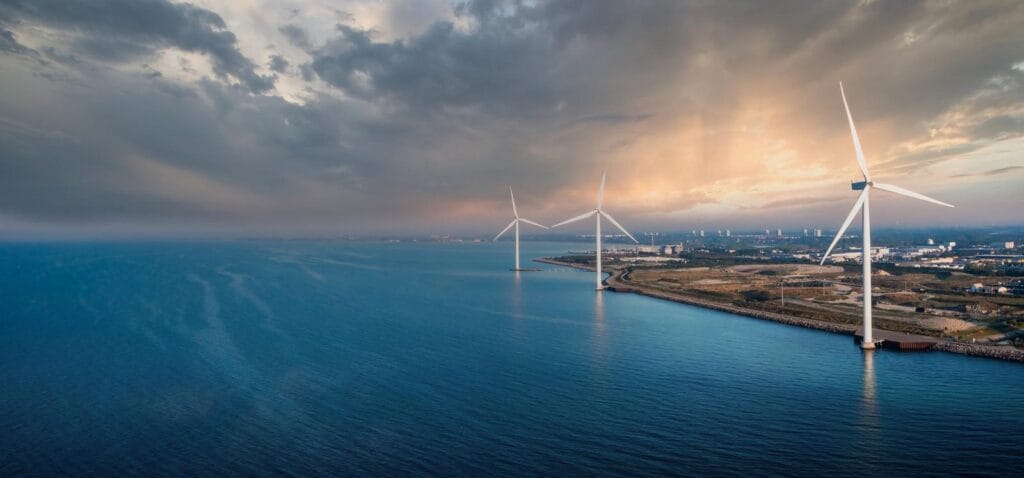
As of mid-2026, Vietnam has approximately 43 offshore wind projects at various stages of development, making it one of the most active offshore wind development pipelines in the Asia-Pacific region. Progress has accelerated following the passage of Decree 58/2025, which came into effect in March 2025 and established a detailed legal framework for offshore wind farm permitting, sea area allocation, and developer selection, covering both renewable energy and new energy project categories.
Early signs are encouraging. In late 2025, the Nam Bo offshore wind farm in Vinh Long province received a sea area allocation for survey purposes, and in April 2026, Pacifico Energy secured a site survey licence for a 500 MW wind project in Bà Rịa-Vũng Tàu, one of the country’s most active offshore wind development zones. Global developers including Copenhagen Infrastructure Partners, Mainstream Renewable Power, and PNE AG are already active, and each wind farm that reaches the survey stage increases market confidence and demonstrates the regulatory framework is functional.
Vietnam’s government is simultaneously investing in a domestic turbine and component industry, with plans to establish two manufacturing hubs by 2030 to produce turbines, towers, and foundations locally. This industrial strategy creates additional opportunities for technology transfer partnerships with UK turbine manufacturers and component suppliers.
Tariffs, Ownership Rules, and What Investors Need to Know
Vietnam’s Ministry of Industry and Trade has published a regional ceiling tariff framework for offshore wind power, with rates ranging from VND 3,079 to VND 3,975 per kWh (approximately USD 0.12–0.15 per kWh) depending on location and project type. These tariffs, combined with Vietnam’s low cost base and the economic growth trajectory of the broader economy, provide a credible return framework for well-structured offshore wind farm investments.
On ownership, foreign investors can hold up to 95% equity in a wind project but must form a joint venture with a state-owned or state-controlled enterprise. Investors are required to demonstrate experience delivering at least one comparable offshore wind project, and must contribute a minimum of 15% in contributed capital with an equity ratio of no less than 20% of total project investment. These requirements are designed to ensure technical credibility while maintaining Vietnamese state participation in strategic infrastructure assets.
How UK Companies Can Enter Vietnam’s Offshore Wind Market
The pathway for British companies varies by business type, but the fundamentals apply broadly across the offshore wind development value chain.
Developers should prioritise early engagement with Vietnam’s competitive investor selection process, debuted by the Ministry of Industry and Trade at GWEC’s APAC Summit in 2025. Building relationships with state-owned enterprise partners before the formal allocation rounds open is essential, and understanding the regulatory framework under Decree 58/2025 from the outset will support faster permitting.
Supply chain and engineering firms have perhaps the most immediately accessible entry point. Vietnam faces acknowledged gaps in port infrastructure, installation vessel capacity, turbine manufacturing, and subsea cable expertise, all areas where British firms hold deep competitive advantage. The UK trade mission of October 2025, which brought 17 British enterprises from the offshore wind, green hydrogen, and energy storage sectors to Vietnam, demonstrated clear commercial appetite and early traction.
Financial institutions and project finance advisors can leverage the UKEF and JETP frameworks to structure investment into the growing pipeline of offshore wind farm projects emerging under the revised PDP8. For institutions with Southeast Asia mandates, Vietnam’s offshore wind development trajectory provides one of the most compelling risk/return profiles in the region.
Risks and Regulatory Considerations
No Vietnam offshore wind strategy is complete without a clear-eyed view of the risks. The most significant is timeline. The revised PDP8 pushed the original 6,000 MW target back five years, and while the regulatory framework is improving under Decree 58/2025, permitting timelines can still be protracted. Grid connection planning for large offshore wind farms remains at an early stage, and the competitive investor selection mechanism is yet to be fully tested at scale across multiple wind projects simultaneously.
Currency and offtake risk also require careful structuring, particularly for offshore wind development projects seeking international project finance. The World Bank’s July 2025 report on Vietnam offshore wind power explicitly flagged the need for stronger power purchase agreement frameworks and clearer grid access rights to provide long-term revenue certainty.
That said, the regulatory trajectory is clearly positive. The pace of reform since 2023, from the original PDP8 through Decree 58 to the revised 17 GW targets, signals a government genuinely committed to making offshore wind development succeed, not merely planning for it on paper.
What UK Businesses Should Do Now
The UK-Vietnam offshore wind investment corridor is no longer a prospect, it is an actively developing commercial reality, backed by government commitments, dedicated finance mechanisms, and a renewable energy policy framework that is accelerating. Vietnam’s offshore wind development ambitions, combined with the UK-Vietnam Clean Energy Partnership and UKEF’s USD 6.5 billion credit facility, provide British companies with a government-backed runway into one of Southeast Asia’s most significant infrastructure growth markets.
For UK businesses, the strategic imperative is to move early. The developers, turbine suppliers, engineering firms, and financiers building relationships in Vietnam’s market today will be best positioned when competitive allocation rounds begin and the 17 GW offshore wind pipeline starts converting to contracted capacity, and to the substantial economic growth opportunities that follow.
Viettonkin advises UK and international businesses on market entry, partnerships, and regulatory navigation across Vietnam’s energy sector. Contact Viettonkin to discuss how your organisation can access the PDP8 offshore wind opportunity.