


The administrative change process involves multiple actors, including the Politburo, the Government, the National Assembly, and key ministries, each of which is responsible for different aspects of the reform.
Integrated Macro-Management
A central principle of Vietnam’s restructuring, as articulated in Resolution 18-NQ/TW, is the shift toward integrated macro-management. Under this model, ministries and ministerial-level agencies are repositioned to focus primarily on strategic, institutional, and policy-level functions rather than day-to-day micro-administration.
Specifically, ministries are tasked with macro management responsibilities such as policy formulation, legal and institutional development, sectoral strategies, planning, and long-term development plans. Their role also includes providing guidance, conducting inspections and supervision, and handling violations within their assigned scope in accordance with legal regulations.
To support this approach, interrelated and interconnected sectors have been reviewed and consolidated under single ministries. This realignment aims to eliminate fragmented oversight, reduce policy contradictions, and enhance the overall effectiveness and efficiency of state management across sectors.
Institutional Transition – Laws and Regulations
Existing laws, decrees, and ministerial circulars are designed around the old ministerial structure. Many legal documents must be revised simultaneously, creating temporary gaps or overlaps until the new legal framework is fully harmonized. This transition is not only technical but also structural. As ministries consolidate functions, entire regulatory chains are being reassigned, meaning that the authority responsible for issuing, interpreting, and enforcing regulations may change simultaneously.
As a result, during the transition period, businesses may face situations where the same regulation is formally in force but practically administered by a different authority than before, requiring careful revalidation of procedures.
Internal Organization & Human Resources
A large number of organizational units are dissolved or merged initially reducing 13 general departments, 519 departments, 219 divisions, and 3,303 sub-divisions resulting in extensive reclassification of leadership positions and civil servants. This carries the risk of temporary loss of institutional memory, especially at operational levels.
Restructuring requires personnel restructuring, including the reassignment, transfer, and other processes of civil servants. The authorities have introduced a number of support mechanisms such as retirement schemes, financial assistance, and other processes to mitigate the impact of the cuts that may occur during the reform.
Inter-Agency & Inter-Sector Coordination During “Overlap Period”
During transitional overlap where old units remain partially operative while new units are not yet fully functional businesses and local authorities may be confused about which agency has competency for specific approvals or services. Clear interim guidance is required to avoid administrative paralysis.
Fewer, More Powerful Ministries and the End of General Departments
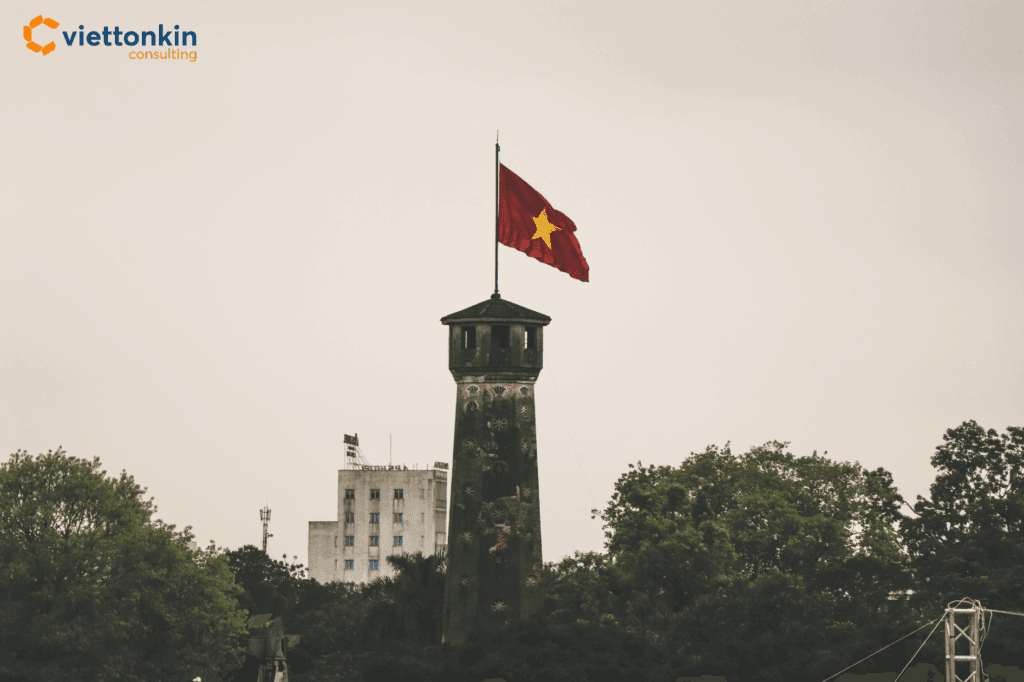
One of the most visible outcomes of the restructuring is the creation of a smaller but more powerful central government. Vietnam’s new government model comprises 14 ministries and 3 ministerial-level agencies, following the merger of ministries and agencies from a previous structure of more than 18 entities.
Equally significant is the abolition of the General Department level within ministries. Previously, ministries operated through three administrative tiers: the Ministry, General Departments, and Departments or Divisions. Under the new model, ministries now function with only two core administrative levels, streamlining internal hierarchies and reducing bureaucratic layering.
Although formally abolished, the term ‘General Department’ still appears in limited administrative contexts, such as within the Government Office.
Decree No. 40/2025/ND-CP dated February 26, 2025 also practically reveals the transition to the new system. It can be seen from the decree that the Provincial Market Management Departments, which were part of the General Department, are transferred to the People’s Committee. The establishment of Market Management Branches under the Provincial Departments of Industry and Commerce, rather than the General Department, indicates that the institution of the General Department has effectively been eliminated.
This structural simplification is intended to accelerate decision-making, clarify responsibility, and strengthen ministerial authority, while minimizing administrative duplication and internal fragmentation.
Implications for Large-Scale Projects and Sector Coordination
The consolidation into fewer ministries also changes how inter-sectoral projects are handled. Previously, large projects particularly in infrastructure, energy, or industrial development often required coordination between multiple ministries with overlapping mandates.
Under the new structure, these projects are more likely to be handled within a single “super-ministry,” which may reduce inter-agency negotiation time but also concentrates regulatory discretion within fewer institutional actors.
Delegation with Stronger Supervision and Anti-Corruption Controls
The restructuring also advances a model of greater delegation paired with tighter supervision. While operational authority is increasingly devolved to lower levels, oversight mechanisms are being reinforced to ensure compliance, discipline, and accountability.
This approach is closely linked to Vietnam’s ongoing anti-corruption campaign, often described domestically as “burning the furnace” a metaphor for systematically rooting out corruption, misconduct, and underperformance within the state apparatus. Government sources characterize this campaign as a positive driver of institutional cleansing, exerting pressure on officials to perform while removing those who fail to meet standards.
By coupling delegation with robust inspection, supervision, and disciplinary mechanisms, the government aims to prevent abuse of authority while preserving administrative flexibility and effectiveness.
“Security in Development”: Integrating National Security and Economic Planning
Another defining feature of the new governance model is the principle of “security in development.” This concept emphasizes the integration of national security considerations into economic planning, sectoral strategies, and development policies.
Rather than treating security and development as separate domains, the restructuring embeds security thinking into long-term economic and institutional planning. This reflects Vietnam’s view that sustainable development requires political stability, social order, and resilience against both traditional and non-traditional security risks, including economic shocks, geopolitical tensions, and systemic vulnerabilities.
By aligning economic governance with security imperatives, Vietnam seeks to ensure that growth, modernization, and institutional reform proceed in a stable and controlled manner.
Read more: Decree No. 236/2025/ND-CP: Vietnam’s Comprehensive Framework for the Global Minimum Tax