
Vietnam’s industrial real estate market is one of Southeast Asia’s most compelling property investment stories, and Taiwan FDI is the single largest manufacturing demand driver behind it. With USD 39.5 billion in registered Taiwanese capital across 3,200+ projects, and Taiwanese manufacturers occupying millions of square metres of industrial land and ready-built factory space from Bac Ninh in the north to Binh Duong in the south, the connection between Taiwan’s outward investment and Vietnam’s industrial property fundamentals is causal, not coincidental. This article presents the data, occupancy rates, land lease prices, ready-built factory rents, and the 2026–2029 supply pipeline, and makes the investment case.
Vietnam Industrial Real Estate in 2026: Market Size, Growth Rate, and FDI Context
Vietnam’s industrial real estate sector is projected to reach USD 19.07 billion in 2025, expanding at a compound annual growth rate of 15.42 per cent through 2033, the highest CAGR of any real estate asset class in Vietnam. The growth is FDI-led: Vietnam attracted USD 27.62 billion in disbursed foreign direct investment in 2025, the highest figure recorded in five years, and the manufacturing sector, the primary occupier of industrial land and ready-built facilities, absorbed the largest share.
FDI investors now treat Vietnam not as a low-cost assembly location but as a long-term manufacturing platform. High-value-added sectors including electronics, semiconductors, electric vehicles, and data infrastructure have replaced garments and footwear as the primary demand drivers of the industrial park market. Ready-built factory demand is growing at 10–12 per cent annually through 2030, according to Vietnam’s Ministry of Planning and Investment, reflecting both new entrant demand and the expansion programmes of established Taiwanese and Korean anchor manufacturers.
Industrial Park Occupancy Rates: North 88%, South 92%, What the Data Shows
Occupancy data across Vietnam’s industrial zones confirms a market operating near full capacity in both major corridors.
| Region | Industrial Land Occupancy | Ready-Built Factory Occupancy |
|---|---|---|
| Northern Vietnam | 86% | 88% |
| Southern Vietnam | 90% | 92% |
| National average (RBF) | — | ~88% |
Northern Vietnam’s industrial parks, concentrated in Bac Ninh, Bac Giang, Hung Yen, Hai Phong, and Hai Duong, are driven by electronics and semiconductor-adjacent manufacturing, where Taiwanese companies represent the dominant occupier segment. Southern Vietnam’s parks, concentrated in Binh Duong, Dong Nai, Long An, and Ba Ria-Vung Tau, serve a more diversified mix of electronics, consumer goods, logistics, and automotive components. Both corridors are adding supply through 2029, but occupancy rates in existing parks indicate that near-term demand outpaces delivery.
Industrial Land Lease Prices by Province: Bac Ninh, Binh Duong, Long An, and Central Vietnam
Industrial land lease prices vary significantly by region, with northern Vietnam commanding a premium reflecting its electronics manufacturing concentration and stronger Taiwanese occupier demand.
| Province / Region | Industrial Land Lease Price (USD/sqm/cycle) | YoY Growth |
|---|---|---|
| Bac Ninh (North) | ~USD 160 | +40% vs 2022 |
| Northern average | ~USD 139 | +4–5% per year |
| Binh Duong (South) | USD 100–250 | +3–7% per year |
| Long An (South) | USD 125–275 | +3–7% per year |
| Southern average | ~USD 200 | +3–7% per year |
| Central Vietnam | ~USD 63 | Stable |
Bac Ninh’s land lease price has risen 40 per cent since 2022, driven almost entirely by Taiwanese electronics manufacturing demand, Foxconn’s USD 4 billion commitment to the province set the benchmark for what premium industrial land commands when anchor tenants of that scale establish. Central Vietnam, by contrast, offers lease prices 50–60 per cent below northern and southern averages, making it an emerging target for cost-sensitive manufacturers in the next expansion wave.
How Taiwan FDI Is Driving Demand Across Vietnam’s Industrial Zones
Taiwan’s USD 39.5 billion in cumulative Vietnam FDI does not sit uniformly across sectors or provinces. It clusters in industrial zones, in electronics and semiconductor-adjacent manufacturing, and in the northern corridor where the supply chain density, port logistics, and provincial infrastructure investment align with Taiwanese production models. Understanding where Taiwan FDI flows within Vietnam’s industrial property market is the first step in identifying where occupancy, rents, and land prices are likely to rise next.
Foxconn, Pegatron, Wistron, and UNIVACCO: The Taiwanese Manufacturer Industrial Footprint
Four Taiwanese companies illustrate the scale and pattern of demand in Vietnam’s industrial real estate market.
Foxconn holds approximately USD 4 billion in total registered capital in Bac Ninh province, producing laptops, circuit boards, and telecommunications devices across multiple industrial park facilities. In 2025, Foxconn expanded two projects in Quang Chau Industrial Park by a combined USD 320 million, a signal that its Vietnam industrial footprint is actively growing, not stabilising.
Pegatron has established a significant industrial presence in Bac Giang, anchoring the electronics supply chain cluster that has made the Bac Ninh–Bac Giang corridor Vietnam’s most supply-constrained industrial real estate zone.
Wistron continues to scale northern operations, and Tripod Technology Corporation committed USD 250 million to a new circuit board production facility in Ba Ria-Vung Tau in 2024.
UNIVACCO Technology leased 29,742 square metres of industrial land at Long Thanh Industrial Park in Dong Nai province in February 2026, a recent, concrete data point demonstrating that Taiwanese manufacturer demand for Vietnam industrial zones continues at pace into the current year.
Why Taiwan’s China+1 Strategy Concentrates in Vietnam’s Industrial Real Estate Market
Taiwan’s China+1 strategy, the systematic shift of production capacity out of mainland China into ASEAN, does not distribute evenly across the region. It concentrates in Vietnam because no other ASEAN industrial real estate market combines Vietnam’s cost base, trade agreement access, proximity to China component supply chains, and established Taiwanese manufacturer ecosystem in the same geography.
Vietnam’s more than 15 active free trade agreements provide Taiwanese manufacturers operating from Vietnamese industrial zones with preferential export access to the US, EU, UK, Japan, Australia, and all ASEAN markets, a tariff advantage that directly translates into the industrial real estate demand premium visible in Bac Ninh and Bac Giang’s occupancy and land prices. The result is that Vietnam’s industrial zone market is functionally tied to Taiwan’s outward investment cycle: when Taiwan FDI accelerates, northern Vietnam’s industrial real estate absorbs the demand fastest.
Ready-Built Factories and Warehouses: The Fast Entry Point for Taiwanese Manufacturers
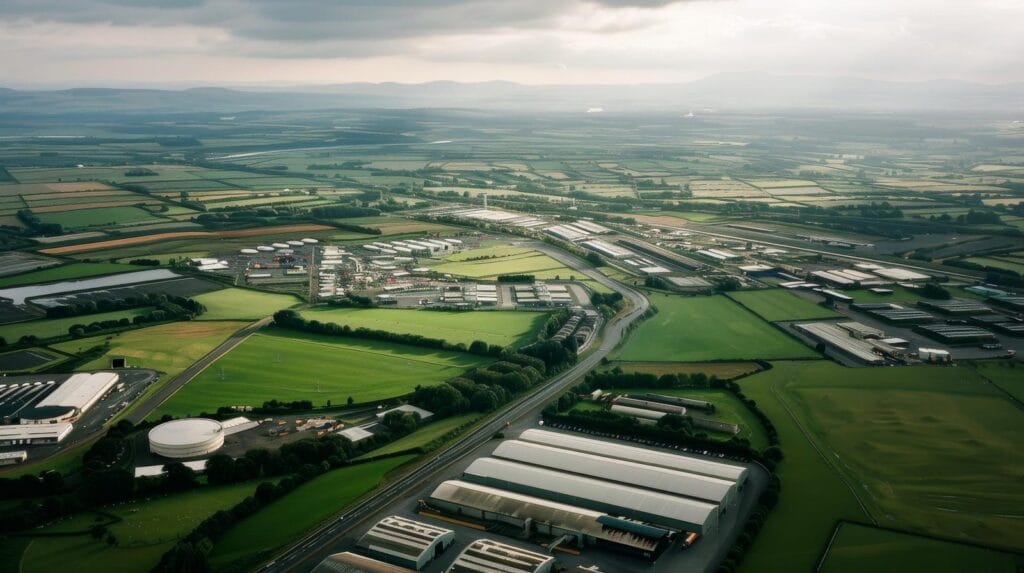
For Taiwanese manufacturers entering Vietnam for the first time, or scaling an existing operation faster than a greenfield land lease allows, ready-built factories and warehouses are the primary entry mechanism. Ready-built factory units, pre-constructed facilities in established industrial parks that allow immediate occupancy, now represent a mature, competitive sub-market within Vietnam’s industrial real estate sector.
Ready-Built Factory Rent: North USD 5.1/sqm vs South USD 4.4/sqm
| Facility Type | Northern Vietnam | Southern Vietnam | YoY Change (North) |
|---|---|---|---|
| Ready-built factory | USD 4–7.1/sqm/month (avg USD 5.1) | avg USD 4.4/sqm/month | +10% |
| Ready-built warehouse | avg USD 5.1/sqm/month | — | Stable–positive |
Northern ready-built factory rents are running above southern rates, an unusual inversion that reflects the premium Taiwanese electronics manufacturers pay for the northern corridor’s supply chain density and logistics connectivity to Noi Bai Airport and Hai Phong Port. Total ready-built factory supply across Vietnam stands at 10.3 million square metres, with a national occupancy rate of approximately 88 per cent. Ready-built warehouse supply is 7.7 million square metres at 77 per cent occupancy, the lower rate reflecting significant new supply entering in 2024–2025.
New ready-built factory supply of over 643,000 square metres is expected to enter the market in 2026 alone, with the 2026–2029 period seeing approximately one million square metres of new leasable area. For investors, this pipeline creates both a near-term leasing opportunity and a future supply risk that underscores the importance of location selection, Taiwanese-anchored industrial parks in core northern and southern provinces will absorb new supply faster than emerging locations.
Vietnam Industrial Real Estate Investment: The 2026–2029 Supply Outlook
The forward supply picture for Vietnam’s industrial real estate market indicates approximately 5,050 hectares of new industrial land entering the market through 2029, with development concentrated in both established northern and southern corridors and emerging central Vietnam locations. For property investors, the investment case rests on three data points: sustained Taiwanese and Korean FDI driving occupier demand, land lease price appreciation of 5–9 per cent annually in northern Vietnam and 3–7 per cent in the south, and a ready-built factory demand growth rate of 10–12 per cent annually through 2030 that exceeds current supply delivery.
Vietnam’s data centre capacity, projected to reach 950 MW by 2030 from 524.7 MW in 2025, is adding a new demand layer to industrial land adjacent to power infrastructure, creating an additional price support dynamic in provinces with reliable electricity grid access. For Taiwanese investors with real estate mandates alongside manufacturing FDI, Vietnam’s industrial property market offers a complementary yield profile to the equity returns available in manufacturing joint ventures.
How Taiwanese Investors Can Access Vietnam’s Industrial Real Estate Market
Taiwanese investors can access Vietnam’s industrial real estate market through four primary structures: direct industrial land lease via a Vietnamese entity (50-year term, renewable); sub-lease of factory or warehouse space within an established industrial park; joint venture with a Vietnamese industrial park developer; or acquisition of equity in a Vietnam-listed or unlisted industrial real estate vehicle.
The land lease route is the most common for Taiwanese manufacturers entering for production purposes. The sub-lease route, ready-built factory or warehouse, is the fastest to occupancy and requires the lowest upfront capital commitment. For pure property investors, Vietnam’s industrial park developer stocks and private equity vehicles provide exposure to land price appreciation and rental income without the operational commitment of direct manufacturing investment.
Contact Viettonkin for further consulting on Vietnam industrial real estate market entry, industrial zone selection, land lease structuring, and Taiwan FDI investment strategy across Vietnam’s northern and southern manufacturing corridors.
Australia & UK → Vietnam FDI